
Endorsement recognizes NurseVetted’s Human Connection Preservation domain; a scored evaluation criterion built on Dr. Jean Watson’s theory to safeguard the nurse-patient relationship
Deerfield Beach, FL: The Watson Caring Science Institute (WCSI) is honored to announce its formal endorsement of NurseVetted, the first nurse-led platform for independently evaluating artificial intelligence tools before and after they enter clinical practice founded by Dirksen Jurado Taguiam, DNP, RN, APN. NurseVetted equips nurses with a structured, credible voice in determining whether AI tools are safe, workflow-appropriate, and worthy of trust. This endorsement affirms NurseVetted as a vital extension of Watson’s Caring Science, one that operationalizes its philosophy into a rigorous, scored standard for evaluating artificial intelligence in nursing practice.
NurseVetted rests on a simple yet urgent conviction: nurses are the most trusted professionals in healthcare, yet the AI tools entering their daily work are rarely evaluated by the people who actually use them. Through a nine-domain evaluation framework grounded in established nursing theory and practice, NurseVetted gives nurses a structured, credible voice in determining whether an AI tool is safe, workflow appropriate, and worthy of trust, before deployment and again after a tool goes live in real clinical settings.
At the center of that framework is Human Connection Preservation, one of NurseVetted’s nine clinical domains and the one built explicitly on Jean Watson’s Theory of Human Caring. The domain evaluates whether an AI tool preserves a nurse’s physical attention and presence during care delivery. It then determines whether it enhances or erodes the human dimension of the nurse-patient relationship. Rather than a citation added for credibility, Human Connection Preservation is operationalized into a scored, structured criterion that every AI tool reviewed on the NurseVetted platform must meet, alongside eight additional domains, the ANA Code of Ethics, Complexity Leadership Theory, and other nursing frameworks.
The relationship between WCSI and NurseVetted began after a conference conversation between the NurseVetted team and Dianne Reid, WCSI’s Program Enrichment Director, about the alignment between the platform’s evaluation framework and Jean Watson’s theory. As AI moves deeper into clinical documentation, decision support, and patient communication, WCSI and NurseVetted share a commitment to ensure the risk of eroding caring and human-centered practice is formally assessed, not assumed away in the name of efficiency.
“Nurses are the most trusted professionals in healthcare, yet the AI tools entering their daily work are rarely evaluated by the people who actually use them. Dr. Watson’s Theory of Human Caring gave us the language to make sure that as AI enters nursing practice, the human connection at the center of care doesn’t get lost in the process.”
 “Nurses are the most trusted professionals in healthcare, yet the AI tools entering their daily work are rarely evaluated by the people who actually use them. Dr. Watson’s Theory of Human Caring gave us the language to make sure that as AI enters nursing practice, the human connection at the center of care doesn’t get lost in the process.”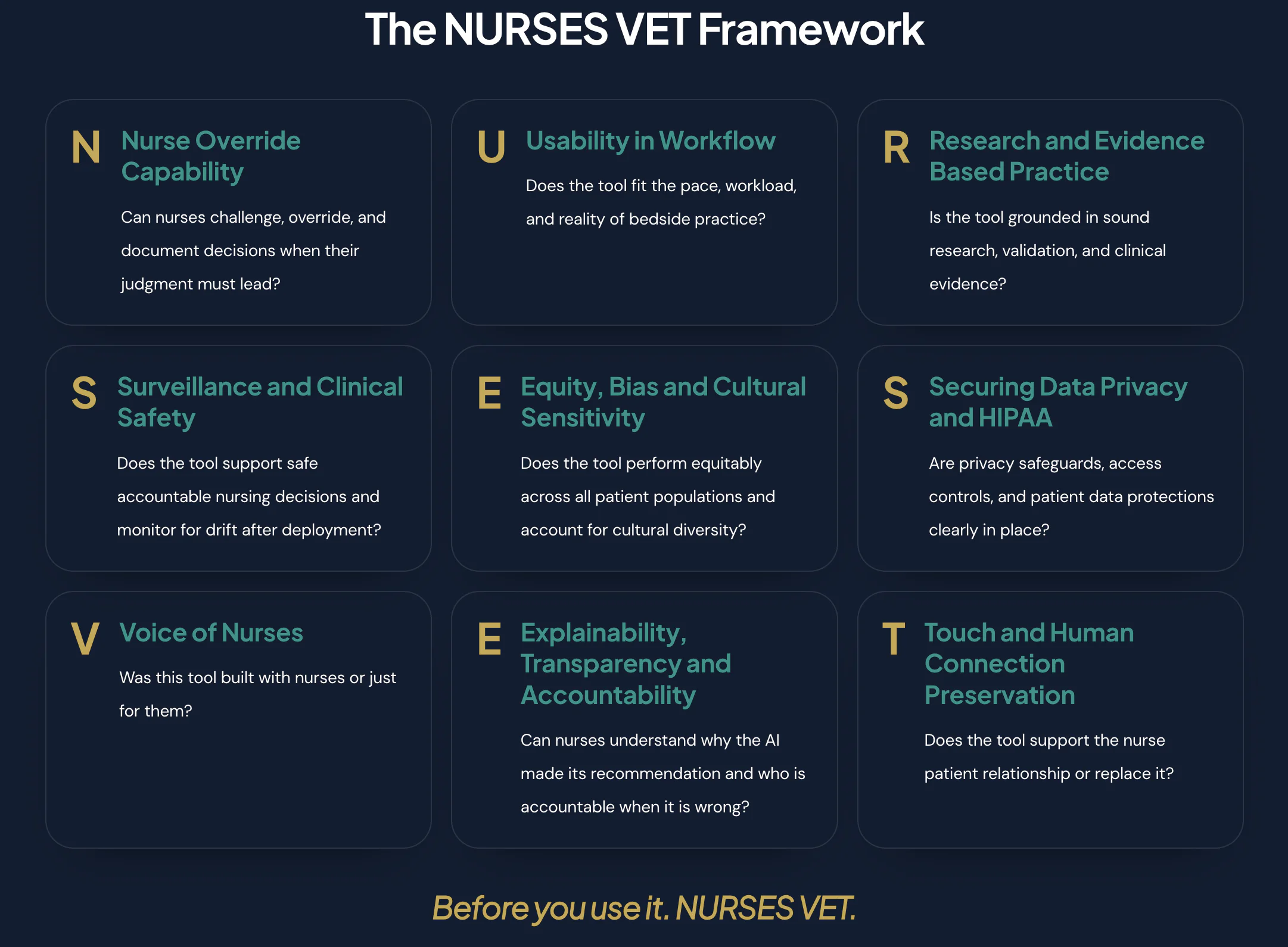

“Nursing judgment has always been the safeguard at the bedside, and that doesn’t change because the tool in the room is artificial intelligence. NurseVetted is asking the questions Dr. Watson would ask: does this technology protect the nurse’s presence with the patient, or does it quietly take her out of the room? That is exactly the kind of rigor Caring Science calls for as AI moves into nursing practice.”
 “Nursing judgment has always been the safeguard at the bedside, and that doesn’t change because the tool in the room is artificial intelligence. NurseVetted is asking the questions Dr. Watson would ask: does this technology protect the nurse’s presence with the patient, or does it quietly take her out of the room? That is exactly the kind of rigor Caring Science calls for as AI moves into nursing practice.”
Share this Page